


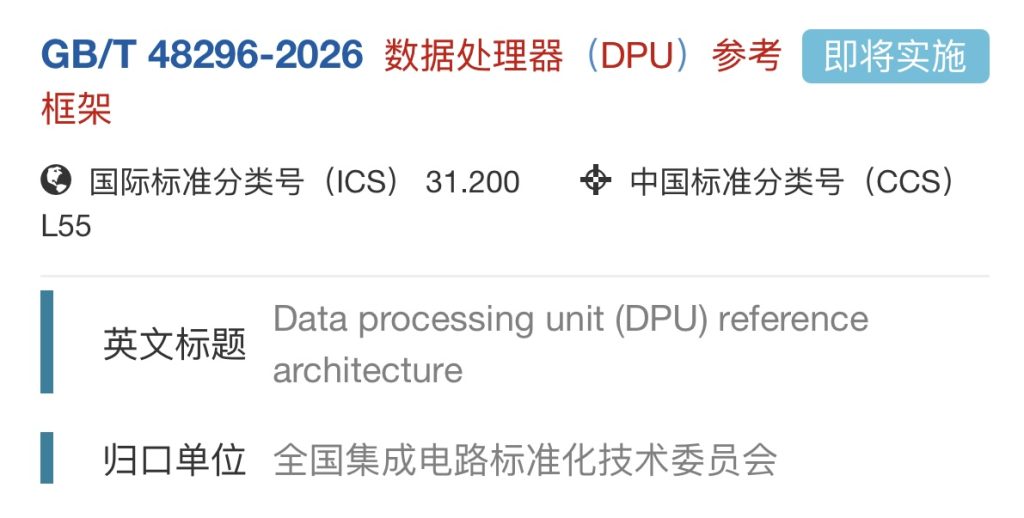
The national standard GB/T 48296-2026, Data Processing Unit (DPU) Reference Architecture, has recently been officially released. The standard is under the jurisdiction of the National Technical Committee on Integrated Circuits Standardization (SAC/TC 599) and led by the China Electronics Standardization Institute (CESI). It establishes a unified top-level framework for the domestic DPU field and defines DPU hardware, software, functions, integration architecture and core performance indicators, drawing a unified technical baseline for the standardized and large-scale development of China’s DPU industry. As one of the drafting organizations, Resnics Technology (Shanghai), Inc. participated deeply in the formulation of this standard and contributed core practical experience to the building of a domestic DPU standards system.
As the “third main chip” of computing infrastructure, the DPU handles key tasks such as network offloading, storage acceleration, traffic scheduling and security processing, and is a core component of intelligent computing centers, cloud data centers and carriers’ computing power networks. During the phase of rapid industry expansion, problems such as inconsistent architectures, heterogeneous interfaces and difficult ecosystem adaptation have long constrained the large-scale deployment of domestic solutions. The release of the national standard opens up a standardized pathway for DPUs from chip design and hardware-software co-design to complete-system integration, helping upstream and downstream vendors align their technical language, reducing the adaptation, joint debugging and acceptance costs for domestic computing clusters, and accelerating the maturity of an independent computing ecosystem.
Since its founding, Resnics has firmly followed a route of fully domestic, independent research and development. Its Stargate series DPUs, RDMA smart NICs, NVMe-oF storage acceleration cards and other products are natively compatible with domestic CPUs, domestic operating systems and the domestic server ecosystem. For scenarios such as AI intelligent computing, distributed storage, public cloud bare metal and virtualization, they provide high-performance, low-latency, secure and controllable network acceleration capabilities, providing the computing base with independent, controllable high-speed interconnect capability.
Taking part in the formulation of a national-level standard is the industry’s recognition of Resnics’ domestic technology route and product capabilities, and also an important milestone for the company as it moves from product development to industry co-building.